
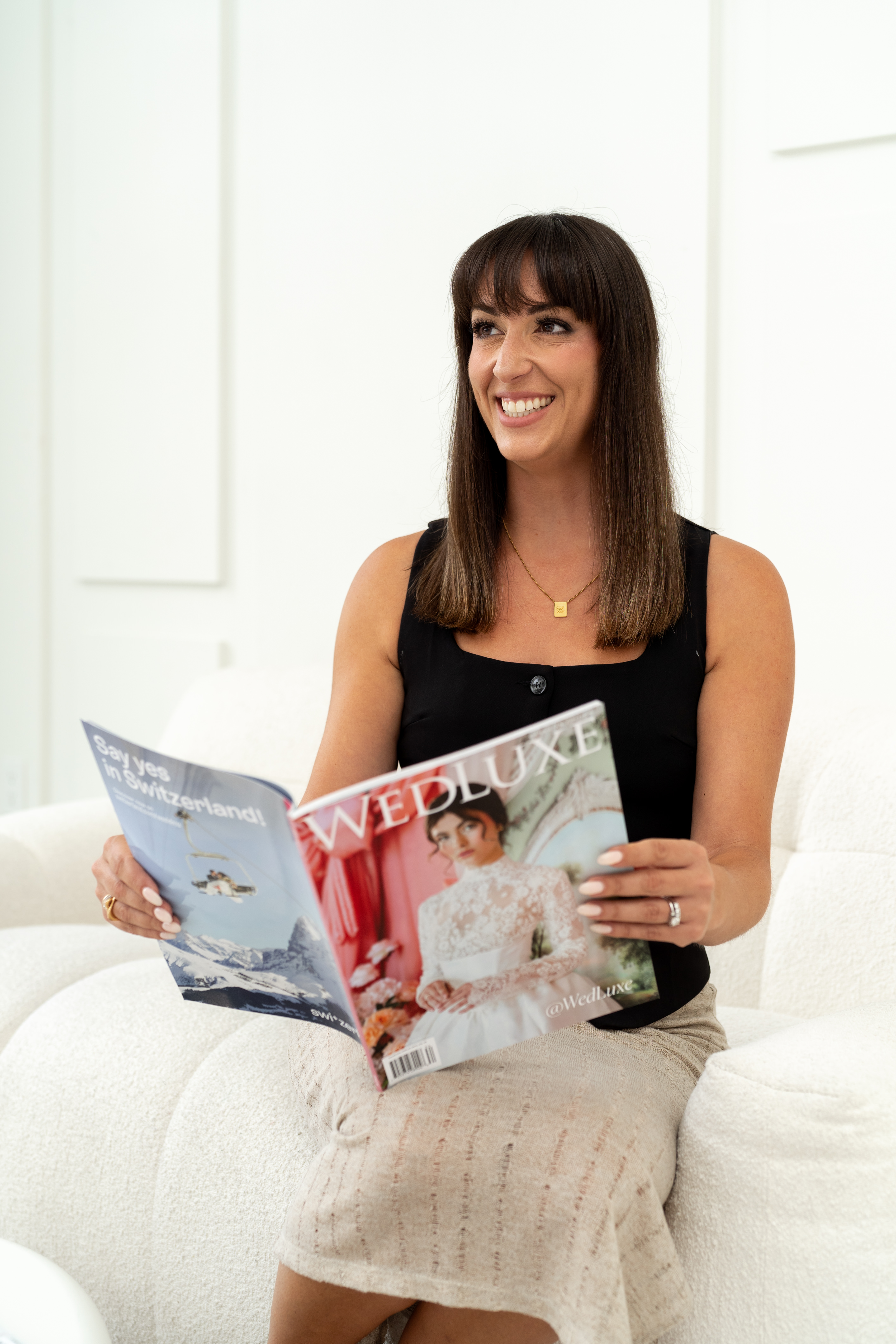
Episode 45 · Season 3
Culture, Business, and Destination Weddings — Claudia Faustino — Canadian wedding planner with Italian roots and a Portuguese heart — on destination weddings in Italy and Portugal, the business fundamentals no one teaches creatives, and why Porto is next.
Claudia Faustino Destination Wedding PlannerClaudia & Co
summary
Claudia Faustino arrives on the WAC Podcast carrying a geography that's hard to fit on a business card — Canadian-born, raised in Italian family traditions, married to a Portuguese man, and now building a destination wedding company that operates across three countries. That combination is biographical texture, yes, but it's also the source of everything she does. The Europe she plans weddings in isn't a backdrop. It's somewhere she knows from the inside.
The conversation opens on food, which turns out to be the most revealing entry point. Claudia and Rui compare notes on how Portuguese and Italian weddings actually work at the table — the fish fork, the two pasta courses, the rice and potatoes arriving together because the sauce needs thickening — and what surfaces isn't just affection for abundance. It's a shared recognition that in Southern Europe, the meal is the wedding. Everything else is punctuation. For Claudia, who now lives in a city where cocktail hours last forty-five minutes and dinner wraps in three courses, the European way asks couples to slow down in a way that most of them haven't experienced before. That's exactly why they fly across the Atlantic to do it.
What makes this episode unusual is what Claudia brings structurally to a field full of people who arrived through creative passion. She studied international business — partly to satisfy her Italian parents, partly because she genuinely loves the framework side of things. She knows the difference between a sole proprietorship and a corporation. She does quarterly business reviews. She tracks what's working and what isn't. In a conversation that touches on tax thresholds in Portugal and Canada, she makes a point that most creatives never do: the moment you understand how money actually moves through your business, you start making completely different decisions. "A lot of creatives who are in this industry don't really work on their business," she says. "Which is what I really try to do quarterly."
That analytical rigor coexists with a strong aesthetic position. When the conversation turns to production — draping from ceilings, florals down every aisle, the North American tendency to fill a room until there's nowhere left to look — Claudia is clear about where she stands. She wants venues to speak for themselves. She'd rather have a traditional Italian folk band at cocktail hour than suspend flowers from the rafters. The villas in Tuscany and the quintas in Porto don't need more. They need less, and intention.
Porto is where the episode sharpens. Claudia has been going to Portugal for ten years through her husband's family, has watched the airport fill up in the past two years, and has decided she wants to be there before it tips from discovery into saturation. She just finished two style shoots — one dark and moody at the Yeatman, one light and airy at Casa de Arcos in Matosinhos — and what she took away wasn't the content. It was the vendors: people who showed up to a style shoot and stayed to style the stationery, who cared about the details of something that wasn't even a real wedding. "This is definitely where I want to bring my clients," she says, "because my couples would appreciate that."
The episode closes on 2026 and 2027 — a year mostly pointed toward Italy, with Porto beginning to fill the calendar. Claudia has kept her portfolio intentionally small, intentionally selective, because what she's selling isn't a service. It's the feeling that you're the only couple she's planning for. At the end of a conversation that covered food, taxes, content creators, and the slow death of editorial prestige, that might be the most quietly radical thing she says.
key quotes
"I really do value the European traditions."
"A lot of creatives who are in this industry don't really work on their business, which is what I really try to do quarterly is try to work on my business to kind of look at the numbers, see what's working, what's not and switch it from there."
"On weddings, stuff always goes wrong. And it's just about us to be like, okay, what can we do to make it right without anyone knowing it even happened?"
"Let the venue speak for themselves, and then putting it more into the experiences. Maybe having like traditional Italian folk music kind of thing playing at your cocktail hour rather than having so many florals everywhere."
"I don't want you to feel that I am doing so many weddings that I don't even know about yours. Because really in the end, I pretty much know the weddings better than they do."
"A video is gonna be getting the speeches and all the sounds and stuff like that, you know, help tell your story, put music towards it. Whereas a content creator is almost just in the background capturing those behind-the-scene moments."
"I need to get in there before it gets a bit saturated, I would say."
overview
New episodes, twice a month. Be the first to hear them.