
Episode 37 · Season 2
"Produto que não tem procura não existe!"
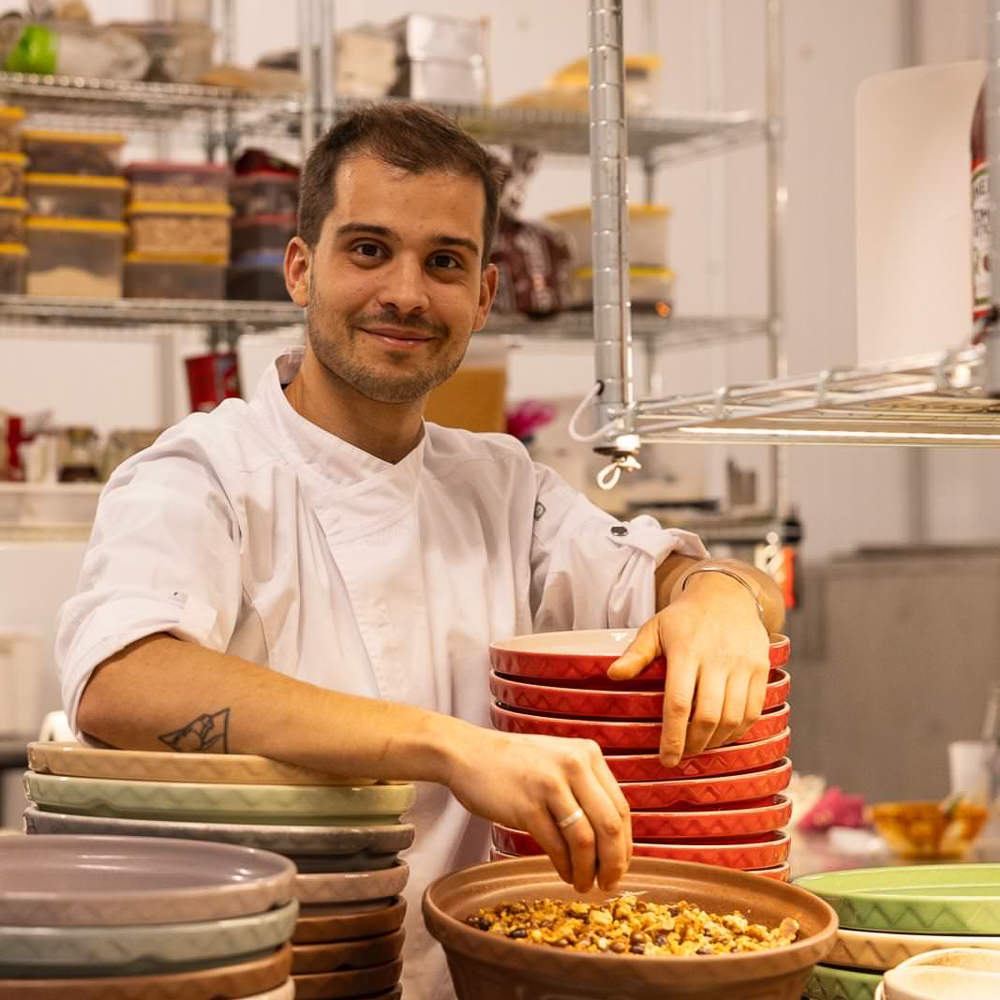
Bruno Ferreira CateringOBO Food Lab
summary
Bruno Ferreira's catering philosophy starts with a simple but radical truth: if nobody wants to eat it, it doesn't exist as a product, no matter how technically skilled you are or how much you believe in it. This concept of product-market fit, usually reserved for tech startups, applies directly to wedding catering, and Bruno has built his entire approach around listening to what works rather than imposing what he thinks should work. He talks about 'The Egg,' his metaphor for understanding the essence of something before you decorate it. For him, this means understanding what your client actually wants to eat, what truly nourishes them, before you think about plating, technique, or presentation. His menus are deliberately seasonal and deliberately constrained—this is not a catering company offering endless choices but rather one that commits deeply to doing fewer things exceptionally well. Bruno discusses the business realities of wedding catering: the margins are thinner than most people realize, the logistics are brutally complex, and your ability to execute on the day under pressure is what separates thriving caterers from those who burn out. He's honest about pricing and its relationship to sustainability. You cannot undercharge and survive long-term; you must communicate clearly to clients why your prices are what they are. What emerges is a portrait of someone who has thought deeply about his craft not as an art form to showcase his skills, but as a service that must genuinely serve the people consuming it. His insights about menu planning, about the psychology of how people eat at weddings, and about the connection between creativity and constraint, offer genuine wisdom for any catering professional.
key quotes
"A product that has no demand doesn't exist."
"Before you think about how to plate it, understand what the egg is—the essence of what you're serving."
"Your menu should tell a story about what you do and what you believe in."
"If you're not making money, you're not sustainable, and if you're not sustainable, you can't serve anyone well."
"Catering margins are thin, and that reality determines what kind of business you can build."
"Listen to what people want to eat. Don't impose what you think they should eat."
"Constraints force creativity. Unlimited menus often result in mediocrity."
transcript + show
episode: 37 title: "Ep. 37 - "Produto que não tem procura não existe!", com Bruno Ferreira" pub_date: "Mon, 09 Jun 2025 05:00:00 +0000" original_language: english source_audio: "6d16ad6b.mp3"
Hello, welcome. I'm Rui and this is the The Wack Podcast. Before we move on to the episode, I'd like to share with you a novelty and that I believe could be the beginning of some very interesting things. I'm finally organizing the first Wack meeting that will take place in Alcobaça on June 17th at the Monastery. It will be in the afternoon and we're going to bring together some professionals who are absolutely extraordinary in our area of weddings and we're going to talk about several global themes in each of the conversations but I believe that the themes will naturally cross each other. It will be a small event, so if you're interested in going, I advise you to sign up as soon as possible and you can do it on the website www.weddingartistcommunity.com.events It has a form, just fill it out and I think all the information is there. Any questions you have, don't hesitate to contact me and I hope to see you there. See you soon and now we continue with the episode. Well, it's a pleasure to have you here. Not here, I'm used to saying this, but I'm glad you're here because today I came to test my girl. But look, I'm very happy, I met you in a very funny way and I've been excited about it because I think it's going to be a cool conversation. And not only that, it's the first time I've had someone from Catering, which is quite interesting. The potential of Mixed Nuts is increasing. Yes, it's increasing, but it's something that ... I don't even know if I was going to talk to you about it, but the logic of the podcast is essentially to talk about the wedding community. Right. And one of the things we're going to talk about later is ... Normally, I feel that Catering is one of those two or three wedding disciplines that is completely apart from everything else. And I think that's funny and that's why it's the first time I'm in contact. So, you talk and you can say that I know you, right? And it's the first time this happens to you, so I think it's going to be funny. But let's start from the beginning. How did you come to stop by the kitchen? A question for 10,000 euros. First of all, thank you, it's a pleasure. We actually met in a funny way. You came to photograph a wedding from which we went to Catering, which was only to have records of the ceremony, I wasn't going to include a meal or anything, and you said to yourself, maybe I'll show up later for dinner. And you went to dinner there and you stayed, and you stayed, and you stayed. Yes, exactly. I was supposed to be there at 4 or 6 o'clock. Yes, you were hired at 4 o'clock and, in the meantime, you only stayed. But two of them eating, actually. How did I come to stop by the kitchen? I started working in a restaurant. I was quite young and my father had a part-time job in a restaurant. And I went to help him one day, when he was more tight on ... He and his team were more tight on work. And I went to help him. I started by helping and I started precisely in the bar function. From then on, I never knew very well ... Ah, when I grow up I want to be XYZ. I've never had ... I've always been very indecisive in that sense. What happens? One after the other, after the next, I stayed. And between the living room, I'm very ... I see what I can do. From the living room I went to the kitchen, I walked, I jumped back and forth, I do within the branch of the hotel and the restaurant, I can do a little bit of everything. Training and so on, all that context that exists, because there came a point when I could do things, but I didn't have any diploma that could present me in such a way. So I had a need to do training. And I've always been, I'm working on something, now I'm going to move on to the next sector, let's call it that, and I ended up doing training from the previous one. That part of the training, more technical, theoretical, more formal, was something that was important to you? Or did you feel the need to find a market where you were? You said it wasn't to cry, but the limit is validation. Yes, of course it is. So you need to be humble and you need to say, no, you actually know, and that is tested by a completely impartial person, and that is, in fact, theoretically pro, is a bar in that, that is ... and it enters the field of specialty of that person. And it manages to validate you in that sense. I was always a good student and everything, that's not what's at stake, but I've always been successful, even in the school sense, and even in schools and everything else, because I got validation precisely about what I knew was right or wrong. And then there's that classic question, it's a little cry, a classic of, we're always learning and we die without knowing. We already know, but there are always things, angles, reasons, foundations, that you learn, contacts, everything worked beautifully. And therefore the need to do the training. Yes, it makes sense. But as you were saying, you went through several of these trainings and you learned the previous one ... Right. Meanwhile, this already happens, I've been working in restaurant and hotel business for over 15 years. You started as a child, right? I started as a child, isn't it beautiful? You see that the other talks to the other, I could even have to be cut. No, but it's fine. I started working when I was 14 years old. It wasn't really a legal context, but it started. People helping. Of course, we're all there. But what happens? One thing that is not much talked about, and there is a lot of this world of, the world of cooking is spectacular, the world of cooking is incredible, and the chefs and the generosity of the chefs and everything else. Very little is said about the generosity of a room. You're talking about a room? A room service. A room service, of people in the room, to carry out the service and everything else. It's a science because you're generating emotions of the builder and the assistant. You're the sandwich fiambre. You're being, I don't know if we're seeing it, and it's press. Hot, turned on to the maximum. The client is upset with the other. The client is anxious. He's anxious, he's never been married before, it's the first time he's done that, there's always a boring aunt. The boring aunt is grateful that she doesn't bathe at the wedding. If it's boring for you, it's going to be boring for the others. If it's boring, don't bathe. The boring one stays at home. There's clothes. And the boring one too. You helped me there. And what happens? This exists on the part of the client. Okay? Whether the client is a client or a guest client. There is, on the other hand, a cooking team. You can't ask, let's get this out of the way, you can't ask a person who works hours a day or who takes a wedding course, whether it's 14, 15, 16, 20 hours, in a hot, humid place, with stress, with 30,000 managers managing the team, and when the table employees all come in, to the kitchen, to the next kitchen, to talk, it blows your mind. Don't bathe. It's assuming you don't bathe. You start right at the base. Don't bathe. I don't know... The expectations are different afterwards. I don't know any cook that blows his mind. And everything is fine. Okay? The science is in not bathing. And knowing how not to bathe. The room service is there in the middle and has to manage these emotions on both sides, plus themselves. And you started in the room service. And I started there, in the room service. Are you fed up? Are you exhausted? Do you have a limit? Do you get to a point where you say, no, I can't be a punching bag? I started going to the kitchen. I'm skilled in hands and all, I don't know what. Son of my mother, who helps with the decoration, so I started making coffees, I went to the kitchen, I went, went, went. I started choosing, for the method, for the technical knowledge I have, for the training and everything else, I chose and I choose, I do whatever, I have no problem, but I continue choosing the kitchen. I manage customers in that context, for me it is difficult, it is really difficult. And general rule of LEGO, I throw it over Tiago and I say, look, go, and he is, with the face of a saint I have, you know, go, very beautiful, get there, do it, buy everything else, and I can rest. But to be digesting the customer, for me, in the event, is really difficult because I have 30 pistons on. So this started when I worked in a restaurant, which is much more difficult to digest the customer than in an event, let's say, and I went to the kitchen, and in the meantime I was assuming, and I was staying, and I was going through the door. Usually I don't know anyone who talks about cooking with the enthusiasm you talk about. Because I chose, I really chose, and I continue to choose daily. If I want, if at any time I want to go to the living room, you know, I go to the living room. If I want to go to the bar, I go to the bar. If I want to go to the set, I go to the set. Whatever. I can do it, in all areas I can. So I purposely choose, I want that. What is it that has the most enthusiasm, in terms of cooking? The kitchen has a master's touch. Do you understand? It's not because of the chef, it's the master. It's the combination of the ingredients. But it's the combination of the ingredients, it's the combination of several phases, it's the combination of timings, it's a chemical combination, it's a combination of all that. And it's a way of... Even when I was in a living room context, one thing that happened a lot was... It's very annoying that employee who talks too much in a room. It's very annoying. It's as important to know how to enter as to know how to leave. But often it ends up existing, more or less, depending on the customer, it ends up easily having an oversharing. Suddenly you go through a series of layers. The kitchen is a way of you having, and you can have freely, the oversharing. In which no one contests you, because what is for you doesn't necessarily mean that it's the way others will receive it. And the kitchen has a lot to do with this ability of... In addition to having all this game, all this gaming, like, this hits here, you pause there, you go to the checkpoint there, and you cross all these lines, because you're even crossing a series of lines simultaneously. It has something that is, as a result for the guest himself, for the bride and groom themselves, is to feed in several layers. It's worse starting from the esclave. You can feed physically, mentally, emotionally, spiritually, all you want. It's nutrition in several layers. Because nutrition is not just what the nutritionist does, that you start to measure proteins. There is a whole rest of nutrition that can be had. No one wants to know about the boss' memories, okay? I'm going to get married. I don't want to know a little about the boss' memories. I want the boss to have his memories, to go home, to go to bed. No one wants to know less. But you feed the person, and you realize that that person is giving you a different game, adding layers of experience and everything else. This happens in marriages and it happens in other areas as well. It's a very cool scene, because you can do oversharing, I have a very stupid idea, and I'm going to make a dish. Once. I'm going to send the boat to the water and I'm going to see how it goes. And suddenly you say, I set fire to the park. It's amazing. People like it. Bruno, do you have more people? I have to have, right? Now I have to have. I kind of have. And it's solved. What was the craziest scene you remember of a situation like this? In which you put together the most stupid things. You told me a story, it wasn't the case, but you told me a story. I have a series. Potatoes, potatoes. I have a series. You always hated that. I hate death. After cooking, you had to react to that being. That being, because I never understood the fascination. And I like to understand. I never get stupid. Okay? I never get stupid. And I like to understand what's going on here, like, my father, to be happy and content, my father, if he gets home, and my mother makes Spanish potatoes, my father is completely humiliated. Completely. And I can't stand it, because, like, meters from home, more than 100 meters from home, I would snore and it was like, Spanish potatoes, I can't stand it. I had to go, exchange, fight, and take a few turns, to be able to understand what is the essence of that, what is that, and realize that that is, man, according to Orlando, what is it? I forget the name. According to... The words are little, they are diamonds, and can be 20,000 things at the same time. Spanish potatoes, it can be both Spanish potatoes, and it can be a dish of cod with potato and tomato. Yes. And I started disassembling. I started disassembling, I turned it around, I put it all together, I had to give to get me to like that. A while ago you were talking about a friend of yours, who eats this first, then that, then that, then that. Okay, I did, because she doesn't like to put everything together. I did exactly that process, but in Spanish potatoes. I disassembled, and then I put everything on the same plate. And I got, for you, Spanish potatoes, for me, cod with tomato and potato. And do you like it now? Do you like it now? Or is it totally unacceptable? It's not so strange anymore, but it's still strange to me, there are some parts of the combination. A starch, an acid, and a cod, a fat fish, sometimes it gets a little confusing. Onion in the middle, for me it's still a little confusing, but I can already see the charm, and I can already see, if I pull more from this angle, from here, if I add the layer of caramelization to the potato part, if I burn the onion, and the onion becomes moist, the onion being more moist, and being more, almost like a pot of onion, you will be able to better unite, and better connect, the element of the cod, and the fat of the cod, with the acid of the tomato. Because it will give you, in the mouth, it will give you an emulsion fusion, because you need to connect them. So, if I pull here, if I pull there, do you understand? It's very confusing. That was a great exercise, Jânio. I hate this, now I'll have to find a way to enjoy it. But did you have any experience in which, out of nowhere, you decided to put together two or three really stupid things, that in your head were really stupid, and then it worked quite well? By the way, you're talking about a process, Jânio. I'm going to find a way to remove this from the black hole of my life, of food, and I'm going to put it in a sunny place. Do you want a house? Yes, a happy house. Happy or just surprised? One of the happiest, and even strangest coincidences, are super simple scenes. Because many times they are really simple, really simple things. I used to work, I used to manage a restaurant group, and we were developing a menu for one of the group's bistros. And we were in the process and everything else, and we needed, that particular restaurant worked a lot with alternative diets, vegetable, vegetarian, gluten-free, and so on, and it included a lot of that. And we needed a cream, that was super easy to serve, that didn't give any work to do, that had a high retirement rate, and that was a great excuse to drink a beer or something like that. And I had one of the best, it was really... Ok, let me open the fridge and put this together. It was an orange paste with black and brown beans, to dip in a garlic bread. And the science is so cool that the cost price of that dish, at the time, was 38 cents, and the selling price was 4 euros. The profit margin was brutal, ok? It was the best-selling dish on the menu. It was the best-selling dish on the menu. And it was completely by chance. It was what you had at that time. When you have... You're a photographer, right? You look at a moment, and sometimes, you take a random shot, right? Yes. But you get to a point where you already know how to take random shots. You don't have to believe it. I see, yes. You already acquired a technical part, a knowledge that... You don't even control it. It works back here. It's not conscious. It doesn't come here. It's back here. You're not always working from scratch. You're always working... Yes. I see. And look, these are funny situations, right? One of them comes from being something you wanted to overcome, a memory you wanted to overcome. The other was a coincidence, more or less. But when you want to create a letter, when you want to create something, how does your creative process work? Do you have a point where you seek inspiration? Do you have a structural basis? How does it work? I start by seeing within the possibilities... I see within the possibilities what is organic and what can be done. I start to see within what are my difficulties what I want to do. Okay? I take a weak point, let's call it that, and now I'm going to study this this part forward. And then I see... Naturally, you have to see the question of seasonality, what will happen, what will not happen, and more, I don't know what. What you want, yes. May is not exactly the same thing you want. And in August, which has nothing to do with what you want in January. And it's often complex. For example, in February, you adapt a menu and you cook a menu for September, your memory can be very good. But it's not there. Your pulse is not there. You have no way. You may have to go to last year, to the menus you made last year, and see what you felt when you made the menus in September. Do you understand? So it's very difficult to make those menus in advance. But between the difficulties, what you want to enhance, what you want to evolve, because you've been doing those dishes for some time, and you say, there's a cool idea, write it down, record it. All of this are stimuli that then lead to compose a menu. But basically, you always wanted... You're talking specifically about weddings, right? Weddings... You have the process in the same way... Service at home, everything. That is, you can write down the idea of what... Imagine, you have a wedding in September, and you can write down some ideas of what would be interesting, but in reality, you just start working on it, maybe a few weeks before, or a month before, or something like that. No, we have to start before, because one thing that happens more and more is that people have anxiety. It's like this... They want the menu closed, right away, in a hurry. You have to give a rating, you have to give a price, and everything else, and everything costs. That's it. So what happens? You have to give all this. When I create a dish, or when there is a dish that has an access, because I have many accesses, I have... It happens. Do you understand? It's lightning style. When I have one of those accesses, I have to register, and I register that dish in the dish collection that we have. We have a list that has more than 700 dishes. Okay? Out of the blue. There are dishes in a perspective of later doing them. Like, you have an idea, you try it, it works, and you write it down. Yes. So, 700, which goes from entrances, main dishes, desserts, snacks, finger foods, everything you want, and a couple more boots. They are all by categories, and everything else, according to style, and so on. You get there, you place yourself, and you have another dish. The novelties are made up by the menu that we communicate, when we make a menu for weddings. We start by conjugating by seasonality, and then we choose which is the best way to give that product to the client at that time. And has there ever been anything that you wanted to do and you couldn't? A dish, a technique, a... There is always, but I choose to forget. I have to choose, otherwise my head will be tied up there. Because I stutter, you see? I stutter at things, in the same way I stutter at failure. I don't have to think about how I'm going to turn this around and how it's going to bother me. If I don't forget, if I don't... You seem to be that person who is extremely obsessed with what he's trying to do and trying to turn it around. When it goes well, it's a spectacular thing, but you also have that difficulty of dealing with it. If it's not going well, you have some difficulty in freeing yourself. You have to train that part, or not? I work against it. I'm against it, okay? If I had a religion, I would be a Protestant. Just for the name, I think it's cool to be a Protestant, because I'm really against it. If it's not going well, the lag does it again. It's up to you. But it's like, it's a wall, there's no problem, it's to break. It doesn't matter, get out of the way. You have to get out. Yes, but then how do you deal with it when you get to a point and say, man, this really doesn't work? Is it difficult? Or did you throw everything away? How do you deal with it? No, a word comes to you, which are four letters, and then an S and E. Okay. A special edition, you know? You can say it at will. And you send it all to Goda. Yes, it happens. Okay, fair. But basically, you hit your head a few times and you say, man, it's over. You hit it. That's it. You hit it. It happens. We make rules to keep it here, you know? There, and many times it's like, everything goes away, you know? Or on the days off and everything else, I bathe, I entertain myself, and I chat, and I don't know what. And then I think I always cook a lot. Always. Everything is painted from one end to the other. Because I'm so attached to that, you know? That even pausing is complex. It's... It's until you find the bottom. Yes. Until you get to the bottom. And do you remember your most difficult challenge? Of those that went wrong. Or that you had more difficult, I don't know. Something that has remained a stone in the sand, what do you think? Last year, I had a wedding that I didn't like at all, from the point I served. The main dish, the first main dish, was a fresh prawns mass, which had... It had truffle and it had cilantro bursts. The prawns were at low temperature, they were exactly on point, they were great. Prawns on point, okay? It's something that people are not used to eating. Say, people are used to eating prawns without seeing the rubber. Okay? And here I have a butter texture. So we don't get confused, it's not the same thing. And one thing is to be right. Another thing is that you like crooked. It's not quite the same thing. And so far, everything is okay. Regarding the point where the dough was, it wasn't my best moment. I had to go, I had to follow, I did everything I could, everything I could. It was hot as I wanted it, it was cooked to the point I wanted it. No. Is it a challenge to serve fresh pasta to 180 people? Yes. I can do it. I couldn't last year. And this year it will be better. Next year, even better, there will be a day when I will say, I served fresh pasta to 180 people. Beach. Exactly. You really look like that guy who can't do it. Sorry, so if you can't do it, you'll have to be strong, you'll have to be tough. Yes, yes, yes. Look, why weddings? When I... Rewind, tape back. I started working. I worked at the registry office. Then, after 8 months, I changed companies. A company that had a restaurant and was doing weddings. I worked for 2 years in a restaurant context. And there is one thing that is, I learned to be a salesman. I'm not a born salesman. I learned to be a salesman. But I was forced, tied up with, you have to sell, you have to sell, you have to sell. And I'm very bad with orders. I'm not exactly a person who... Yes, sir! And what happens? Being bad with orders, it didn't work. In the room context, when it was, you get an orange, you have to squeeze it until you know the peel. That was squeezing even to the last. So there was a need of, he doesn't work badly, he's clean, but he doesn't sell. He just has to change sections. So he has to leave the restaurant and go to the catering. I had my first wedding. And the embellishment, the motto, the totars, there's the kitchen team, there's the living room team, everyone is working for the wedding. That's a style, a... It's a mission, it's like you're going to do a trick. You know? If someone falls, I don't know. What do you call it? It doesn't matter. You break a leg. You know? In a puddle. That's worse than the potters. And like, in a puddle, and you have to deal with that, there's a motto, and it was a scene that, like, gave you class. You had class. Suddenly, we're all from 5th to C, and it's 5th to C until the end. You can say whatever you want, but 5th to C, no one moves. And you had to get out of the scene. The thing that gets you out of the scene is, from here and there, I don't know what, you had to be attentive. And that game, the anxiety, along with the stress, put the volume at maximum. And suddenly, like, there were still the screams, and how do you suffer, and how do you protect, and how do you... You know? That adrenaline... There are people who like to drive at 200 in the car. You know? I like to get married. It beats more than 200. Yes, yes, yes, yes. That, without a doubt. And look, what is it that... Maybe it can be a little bit in that sense, but... What is it that marriage brings you, that you can't get anywhere else in your life? Is it that feeling of belonging? Or the question of creativity? All above, or something else? A very cool scene. There are pop-up spaces. You create, you do, you close, and that's it. This requires an absurd amount of money. To make a pop-up. If you get married, you have a pop-up space there. You are creating a scene, you are creating a process, you are creating a language, you are creating a concept, an aesthetic, all the words you want to apply, in which you, in a controlled atmosphere, and in a way that everyone is turned on the same, you can create a system there, a language, that you can't create anywhere else. And many times, if you take a piece out of context, you take that out and do it on the other side, it doesn't make any sense. Absolutely none. It works there. And to be able to... I can't... Imagine I'm making a buffet, imagine I'm making a decoration, imagine I'm making a cake, a main course, a filling table, a table... Whatever it is, I can't do both the same. I always start from scratch, and I have the scene of being the son of my mother, I put the cheese, the way I put it, I put the piece of meat, whatever it is, that speaks to me, it's a language that maybe you don't hear, it's a language that maybe other people don't hear. But that's speaking to me, and I know what the right of that is. I know. Why do I know? Because that's speaking to me. Maybe no one else is listening, but I don't care either. That's the way it is. That's what it's saying. Do you understand? And you can, suddenly, respect the language of things, create that in that atmosphere, and then never see it again, it's cool for those who have the scene of creating, create, develop, do, and new, new, new, new, new, new, new. Do you understand? Like, in a restaurant, you get to a point of... If you're serving customers for half a year, you get to the end of half a year, the customer is not autonomous, it's not a heterosexual, it's no one, it's one more. In a marriage, you get to a point where it's one more, there are wedding factories, everything exists, it's a business, you give money, it's perfect, it's great, it's your life. There's no problem. We like to make a scene, personalized, adapted, cut and sew. Completely. Cut and sew. It's this, this, only this, and so on. Like, things have to work, there's a logic, the logic has to match, the common sense too. What makes sense for your marriage, doesn't make sense for other people's marriage. You're not the same person. It doesn't make sense. And to recreate, to get there, to speak that language, to be able to do that in a completely isolated way, and then you never do it again, you're not even married tomorrow. You're doing something else. Do you understand? Just that you're not married, for me it's cool. Do you realize that the way you think about marriage, within the catering part, is completely different from the rest of the crowd? And there we go, we're going to lengthen that part, but most people want to get to a point where it's factory, it's basic, it's routine, and it makes everything easier. They want the IKEA of marriages. I'm for it. Basically, yes, yes. We don't do it, we do it once in a lifetime. And now we've come to this point, which is one of the most interesting and less interesting parts for me, how was the egg born? And then, in that process, you'll have to explain the name, which was one of the funniest things I've heard in my life. The egg is, in several layers, the fruit of chance. Completely. I was out of the country, I was out of the country working, I had just returned from Portugal, I got here, I started working and everything else, normal, quiet, at the end of mid-year, there were projects that wanted to be done, normal things, like house, car, all that stuff, and it was like, okay, this is not working, it's not enough, and I've always had a lot of... I'm a person who's always thirsty, you know? Like, I'm always looking for the next cold, you know? I'm looking for the next scene that makes me... It's here, you know? It's a lot here, and like, it comes out, it just comes out, it disappears. And that was bothering me, and I sent myself abroad, I sent myself to Switzerland. I face something called COVID. Last plane, I come back, I get there, and I, who had said goodbye the day I just got back from Switzerland, I don't have a job, and everyone is... You've never been in a phase in the world, like at the beginning of COVID, where everyone filled a diaper. There was no one who didn't have a full diaper. Today, it's super funny to think about it, but at that moment, on that day... In March 2020, we were all... The last event before that, that had happened, where everyone filled a diaper, was on September 11th. You have September 11th, and then you have COVID. But even so, it wasn't the same level, because although September 11th was more focused in a certain area, while COVID was all over the world... And you realized that it was more or less stagnant there. Yes, from then on, no one was interested in Portugal. And it didn't come to you. Yes, yes, from then on, this was the same thing. And in COVID, it happened like... Like, you're in a diaper, and you're even on your back. Yes, yes, yes. It's life. Exactly. I'm familiar with that. With the concept? In a literal way. Right. In a literal way, yes. What happens? In two weeks, my house is quite small, super small, really. It's a living room, a bedroom, a bathroom, and that's it. I washed the curtains three times in two weeks. I washed them, ironed them, and then ironed them in a place that wasn't supposed to be very straight. And I said, fuck it, I can't. My parents had a supermarket, and the old lady used to make some pancakes there. Okay? And I... I burned the oven. My mother had a marble table from the flower stand. And I... Pancakes. The fridge, I started using the one from home, and I started at the gate of the garage of the house. Okay? I put a table there, and that's it. Do you understand? I have an oven, I have a box of all this, I have a table. Do you understand? The mixer goes with this hand, I smooth it, and it goes on. Look, not even on purpose. When did we turn 5 years old? April 5th. Right. April 5th we did... Ube turned 5 years old. Okay? Which was the first cake. Then it started with sweets. Of the sweets, customers, people known, who were customers of sweets, asked, we know you make snacks and everything else, how does that work? And I started to work, to go to these people's house to cook, for my first lunch, there were 4 people. Okay? Cool, but I don't know what, everything in peace, quiet and everything else, but like... It's been 3, 4 years. More or less. It was blossoming and... Super important, and I think I told you this, I started, when I went to buy the ingredients to make that first cake, how much did I take in my wallet? Do you remember? I don't know. I took 10 euros. Until today, Ube, for me, is 10 euros. But in what sense? I started with 10 euros, and so far, they are still 10 euros, because it was everything that was, everything you saw, everything that is, is the result of those 10 euros. Okay? And they are my 10 euros. No one will take them from me. But they are still 10 euros. Every day I go back to 10 euros. Every day. I go back and everyone who works here goes back. And everyone knows that. Every day you go back to 10 euros. You have no idea. You're always there. Okay? And I never know this. But you evolve, and you're getting there, and you're increasing. The lump is increasing, you see, slowly and progressively. Before, in the same phrase, before, every day, you see, it's always abyss. You see? But it's cool. And the truth is one, you also don't know how to do anything else. You'd figure out what to do, but you really do it well. We'd figure it out, but... And now the name, explain it. The first name... I don't know if you understand, how did you explain it to me? How did you tell the story? How did I tell you the story? Yes, I don't know if... When we met, we met in Melos, right? After Porto. And in two or three phrases, we realized that we were both from Guimarães. Right. And you said... How do you order a steak with a horse egg? Right. In Guimarães. You order with an egg. You order with an egg. Right. And basically it's the egg. The egg is the egg, it's an egg. It's just an egg. It's just an egg in Guimarães. Right. I loved this. The egg thing has to do with something very simple. The egg is a product. A lot of people, and frequently, and in weddings it's a lot of this. There are people who increase the structure, and complicate, and complicate, and complicate, and go, and mix, and all that. And suddenly, like, Rubik's cube doesn't have one color to match the other. It has six faces, nine squares, but they don't even match each other. And that gives nerves. It's up and down. It's simplifying. It's going to the smallest. It's going to more basic things. An egg... You... In my understanding, you don't have any product that has so much potential, food product, so much potential, and that is as complex and as simple as an egg. It's already pretty clear. Plague and all that, mitochondria and all that. Right. It has all those things. If we're going to disassemble it anatomically, it has a lot of things, but like... And then I like the part that gives it personality. Because it has. It has the blood in the war. It's like that. It's assumedly like that. It's what it is. Do you understand? It's not to stir. It's not to... Oh, I like it more or not. No. You want it, you want it. You don't want it, you don't want it. But it has personality. It has this. It's tempered. Do you understand? It has affection. And it has... Assumptions in that way. It's an egg. It's just an egg. It's just an egg. An egg. I loved it, I loved it, I loved it. Look, let's... Let's move on now. Oh, no, wait. I had something else to ask you. Oh, I loved that. Although I think anyone who is listening to us at the end of this time has already realized this, but there's a comment of yours on Instagram that I loved that. You have a picture of some guests. Misericórdia. You have some guests. And your comment is... I like to panic. Right from the start I feel like there's no security network. What do you mean? In the simplest way. This happens to us at the beginning. Like, when we started doing events and everything else. We had to actively go... We didn't look for work. We didn't ask anyone, please let me do my wedding. But like, you have to get used to it. It's that flag, the flag of... I'm here. Hello. How are you? Now that we're in a space where, fortunately, people are already starting to live with us directly because of that. About two weeks ago there was a couple here. They want to do their granddaughter's baby shower. And she says, I want some rice cakes, some buns, some fritters and everything else. Well, I apologize. We couldn't help because we don't do it. It's just that we don't do it. And we're not going to do it. You can ask for a lot and you can want to pay whatever you want for them. We just don't do it. I'm not going to buy rice cakes, fritters and sell them to you. I'm not. At the limit, I would do them. But like I said, and now, being stylish on the podcast, we're going to do a callback. Going back to nutrition, I'm not going to give you a fritter that I'm going to reheat in a stove, that I'm going to give you half-baked so you don't eat it cold, that at the end of the wedding you're going to throw up. I'm not going. Period. And we're not going to have this conversation. I've already communicated. I'm not going. There are conversations and there are communications. Since I'm not going to do it, we have a series of alternatives that can occupy the same space for the same person, the person can see what they're going to eat, but the person never tasted that combination, never tasted it that way. And so this happens more or less as follows. You're crazy, but whatever. You get to the wedding. All right. When the guests come to the table, the guests see a practically empty table and they don't know anything. Nothing. The guys are like... There are already customers who entered their house, who found out that they had 40 people and he entered two. There's no food! You're asking for it. The oven is over. And now? And he leaves the door. And him? Maybe they'll stop. Because we're producing at the moment. You understand? You're going to deal with it. Because the first thing that can happen, if I put a rice cooker there, if I put something you know there, you're going to grab that and you're not going to let go. The first thing is, you hit the table, whatever the concept is, whatever it is. It's important that you don't know anything so you're available to try everything, because you know, I'm going to have to eat. I'm going to have to dig in. So, I'm going to lose everything. The safety net is over. It's back there. And now I'm free, light, loose. It looks like a pardalinho. It's good to send me. And you sent yourself. And you have no problem. Everyone tries desserts, sweets and everything else. The Portuguese usually have no fear there. I understand that the main dishes must be non-traditional but consensual. Okay? They are very different concepts. But the entrances, we're going to shoot the balls for the clubs. Yes, basically it's like that. You know that during the meal, you're going to give food to people, they're going to be fed and then you have that little base. But other than that, it's Siga Mundo. Other than that, it's Siga Mundo. Now, I know perfectly well what's going to sell more, what's going to come out more, what I'm going to have to produce more. I have a perfect understanding of this, because there is nothing new under the sun. Okay? And your guests are not from other countries. They don't lose money, do they? So they kind of get into the statistics here. And I already have that company statistic. How does it work? Okay? I already know that if the client with this type, with this type, with this type, because I have metrics, because I'm not from Lourinhá, I know how it has to work. Are you getting it? But the first scene is, you have to hit with the... You have to fight with the wall, man. You can't know anything, like... It's over. Everything you knew, everything you believed in, you know? Ok, she got married very well, beautiful, cried a little. But you don't know anything anymore. You don't know anything anymore. Now I have to start eating. I don't know. But what? I'm going to eat. Look, this is the end. Is it good? Look what? Have you tried that? Have you tried I don't know what? I've seen that and I'm going to like it. Almost for sure. And suddenly, the food is the subject. But I guarantee you, the food is always the subject. We do weddings, we do smaller events, we do accompaniments, we do a series of scenes. The food is always the subject. Always the subject. And you can eat, disconnect from what you eat. Because the leftovers can stay. On Tuesday, at lunchtime, when you don't have time, you take out the cold rice and it stays. The leftovers are cold. And you, in the base of despair, eat those leftovers with a cold rice. And that's despair. It's the wedding. She had two hours in the hairdresser, nails, she, I don't know what. You've already developed 400 breaks between dresses. And you're going to eat leftovers. It's fair. Coffee? Are you going to wake up? No? Explode? Yes, it's fair. Look, you're crazy. Let's now move on to the other side, which is also always interesting. Especially when you have such a creative and artistic mind. How do you deal with the business part? Money management is something you like. You have to be. You joined and even had fun. How do you deal with that? I don't deal badly. It works well. I'm not... You're very organized. I'm not like that in the lab. Are you organized in general? No, I'm chaotic. And aren't you organized in your chaos? I'm organized in my chaos. Right? But as I always have fires to put out, I hold... There's an English expression, classic, and I think it works very well, which is People Hold Candles. And people hold candles in several ways. Okay? And this disassembles in many ways. There's an amazing poem by Edgar Allan Poe, amazing about that. And, like, if I'm doing a scene... I can be managing, sending invoices, simultaneously writing a menu, managing any scene that's in the oven, any scene that's beating, I'm still coordinating anything else, and I'm waiting for a call. I do all this at the same time. Management, perhaps, is that part that I'm less... less focused, because I can leave it for later. Right, but in the current management part, but when it comes to defining prices, vision, the strategic part of management... Oh, that's math, it's an Excel sheet, and math works for me. Explain it to me. What are your processes like? Because math... Sometimes the problem is... When you get into math... Management and cost control. No, no, management and cost control. You apply formulas like, this has to be this. Yes, yes, yes. This costs me this, this is the time it takes, the hours are this, I want to have this, this is the profit, this is the value, this is what it costs me. I want to have 20%, this is the cost. This is X, my fixed income, how much I pay in income, in light, in water, and so on, and the average, or what I have designed, is X. I plan to serve this year 50 people. The X is divided by 50 people. Each person will have to pay that fraction, depending on the time of use. Ah, a communion is 6 hours, a wedding is 10 hours. Okay? So, the communion customer pays 50% of what the other will pay. Now, let's all understand the following. This is business, this exists to make money. Particularly, my person makes money. I don't live from the air. Okay? Whoever lives from the air doesn't need me either. Therefore, you will have to understand. This exists to make money and to explode wherever I want, because no one has anything to do with it. Why? That's the good part. But it is often where a large part of the guys, mainly creative, end up crashing a bit. You like so much what you're doing that sometimes you have the difficulty to define, to have prices. First, do the math well. This is an important point. And then decide how you get to the numbers of what you want. For example, you gave me an example of maybe 50 customers. How do you get to that number? Is it something that ... You have to disassemble. I worked in a particular restaurant and I had a boss, who was Filipe. The guy was sick. Sick. You were making a broth, for example, and he put your stopwatch and told you, in the technical charts, that broth can only boil for 2 hours. I don't have the gas to do that anymore. Solve it however you want. And that can only boil for 2 hours. And you had to solve it. Because that exists to make money. When you have to go get it, first of all, there's something I don't get into. These are price wars. I don't get into them. First, because if I get into a price war, I will allow other people to attribute the price label to my work. And they don't know it. Even because the work hasn't happened yet. There may have been others, but not that one. How are you going to negotiate customers? You have to go get tools. When you go to a tool store, we are not sponsored, but imagine Leroy. When you go to a tool store, you can buy a shovel and start digging, right? Do you know what's in the next section? A ladder. Go up. Don't go down. Go up. Don't dig. Go up! What's the need to dig? I know this is only good for the customer. I have the perfect notion. The customer pays if they want, and if they think you're worth it, it's because the customer wants it. Okay? I'm the person who respects the customer's money the most. You can have the same menu. You and someone else can have the same menu. The structure is different. One is farther, one is closer. Whatever it is. One changed the entrance of the other. The price of the wedding will be different. There's a formula for this. Okay? I didn't... I didn't take that number out of my head. Like, it didn't fall, it didn't rain. I did math. I did math. I made a forecast. I, for everyone... I create the menu. I make the menu and everything else. And I, for everyone, for each entrance, for each main course, I plan to spend X, such, such, such, such. I went to consult last year, I put together the inflation rate. I know what the prices are, approximately, and theoretically, this year. Do you think I don't know that eggs always go up on Easter? They also go up on Christmas. I know, I know, I know perfectly well that they go up on Christmas, they go up on Easter, and in January, at the end of January, beginning of February, they tend to go up. July, August, they're always lower. It's not new. It happened last year, it happened two years ago, it happened three years ago. It's all studied. Now, go get the tools, go get the things, and do the math. Start by realizing that you're going to spend X, X and X. What employees are you going to need? From which category? How many hours do you plan to spend? Okay? Next, you take this, disassemble all that, calculate the prices of everything, you get there and put your profit margin, which is... And it's not a profit margin in percentage. Calculations in percentage are good for analysis, they're not good for math. For accounts, they're not good at all. Because if you plan to earn 10%... Yes, yes. 50% can be a lot, but if it were 50% of €1,000... I've seen people earning 50% or 100% and losing money. Yes, yes. Do you understand? You may be selling a rice cake. Yes, yes. 50% of nothing is very little, right? Not more. 10% is a lot. So, from here you say, with this marriage I have to earn €1.25. Okay. Divide. Be it €1.25, be it €1.25 million. It's the same math, it's the same amount. You get there to the cash register. Buttons. You get to the end. Give the price. Are you satisfied with it? Do you think that's worth it? Put yourself to the test. Do you think that's worth it? It's worth it. Are you not satisfied? Start again. Don't hammer the price. Start again. Find another way. Turn the nail in the head. Turn it around. Like, turn my pony around. You can't go any further. Whatever it is. Turn it around. Find a way to be happy with that. Now, hammer and suddenly say ... No, maybe I'm going to get married. I'm just going to block my whole week. Give the work of this whole process. More costs that I'm not controlling. Because there's always a scene that runs away. And there. I'm going to earn €400 in a wedding. Don't go. You can't. You can't. You can't. You can't. How do you see success in this story? What is success for you? I'm organized in my chaos. I don't look far ahead. I have to make a lot of expectations. Because I get very ... I quickly and easily get frustrated. So, like, I can't be here saying ... In ten years we'll be there. In five years we'll be ... I don't know. And I think there's a scene that is ... But do you think about what you would like to be? Not necessarily you. I want to be there. But do you think about what you would like to happen? I don't want to be sad. I don't want to. I really don't want to. Seriously, I don't want to. No, but so many expectations, right? When you don't have ... A business. You can have a concept. You want to create the business. Create. The business. You get it. You write it on paper. You have the business. The business is yours. From there, the business will be defined. As much as you. There is a very cool Portuguese concept. Who has business is the one who does what he wants. Exactly. It doesn't happen because you have a thousand and one patterns. Usually those who say that are those who don't have their own business. Usually. You have a thousand and one patterns. Yes. Do you get it? When you have ... It's very easy to ... Any search happens. You have to give one from top to bottom. Do you get it? Someone ... And you even work alone. Because you ... Your business is you working alone. What? Are you going to put yourself in front of a mirror? Are you going to pass the color to yourself? You pass, you answer. Yes. It's fucked up. It is. In good Portuguese it is. And I dealt with it for two years, because for two years I worked on this alone. Do you get it? I dealt with all that. I don't want to commit to 10 here, I don't want to commit to 5 here, I don't want to commit to anything here. I go where the client goes, whoever wants, depending on whether I'm willing to close the deal on that. Do you get it? If I agree with those parameters, with that search, with those procedures. Okay. All very well. I go where the client goes. I go completely where the client goes. I guarantee you that in two years, this will not be a shower booth. You know what else? If I have to sell shower booths, I will know how to sell shower booths, I will sell shower booths my way, in a cool way, it will give money and everything else, I will be satisfied, happy and content, and say, I'm glad I left the kitchen. But I guarantee you. I can't. Yes, but it's spectacular. And I love that about you, that it's that perspective you have, you talk about what you do, the kitchen, the wedding, with a passion like few others, but at the same time, you have that detachment, I know this is a bad word, but it wasn't meant to be, but that free form of, I love this, but if it wasn't, it can be something else, right? In a way, it's the same perspective you put the clients to make, in relation to your food, which is, I'm going to have to eat, so let's experiment, and it may be that some things are spectacular, if you think about it in your life, like, I'm loving this, but maybe what I love the most, I haven't tried yet, because you're not afraid of that search, right? No, that's dealing. You're going to have to deal when the time comes. And I think, above all, that you can always, you have a choice. You have a choice in the way you deal, you have a choice in the way you feel, you can choose. You're not what you are, you're just one of your choices. So, if the X happened, if you hit the car, and you want to be upset, you can be upset. If you don't want to be upset, you can not be upset. Although that was, in fact, a lapse, it was a mistake, I don't know what, it shouldn't have happened, and, damn it. Right, but I can choose not to be upset. Yes. One thing is what happens, another thing is the way you react, to what happens. So, that's it. You're going to have to deal, and you're going to make life a little easier, and there's nothing wrong with that. It's just that it doesn't help, it doesn't take you anywhere. Nowhere. Unless you have an extra cent or something like that. An extra cent is very good. Look, let's go now, let's go to the final phase, let's finish here with two or three points that we've already talked about a bit, which are always funny, which is, how do you see the catering industry in Portugal as a whole? And how do you see your future? Because you enter, your way of being, and, fortunately, I have met one or two people in a similar way, which is super refreshing, but still, there are very few of you sailing in a sea of people who want everything to change from scratch. How do you see it? How is it? How do you see where it's going? And how do you feel sailing that path, or that sea? Tell me something, if you go out on the street, and if you go, you go out, you go out here, do you find someone who doesn't deserve a slap in the face? I miss the times when women didn't vote. Yes, there's always someone who says those things. Yes, but from then on, naturally, you don't find anyone. Right? Right. When there's the evolutionary part, you don't have a choice, no one asked you. That's right. The process... But this happens because there are those people who live ahead of their time, who do things, and then others are forced to... There's always... There's always... There has to be always a first. She doesn't live ahead of time, she lives in the right time, there's no one ahead of their time. Ok, yes, but... I know it's a way of putting it, but, normalizing, all people, there's no one ahead, there's no one behind. We're a little behind, don't lie to us. Ah, we all know someone, unfortunately. But what happens? There has to be someone who starts breaking stones. Right. From there, there's no choice. The aunt, ok, who, at the wedding, if she doesn't drink beer, roasts steak, it's not a wedding, this time she doesn't come. If everything goes well, if the life cycle is all organic, there will be a day when, happily or unhappily, one to one, the other to the other, cross-eyed, the aunt is no longer here. There won't be anyone to ask about the steaks and beer, and maybe everything will be fine. Right. Therefore... And that person has already been born. Right. Therefore, at the limit, we are working for her. We are not working for the aunt. The aunt is already married. She doesn't count anymore. Right. At the limit, she will be 50 years old. She knows very well where she wants to spend her 50 years of marriage. She knows very well, she knows since she was 30. She already knows, half of it was coming. She already took off her towels. Now, what was born and everything else, that she still doesn't know, that still doesn't give anything as a guarantee, nothing, are ways of being different generations, different generations, ask and seek things. Everyone has their own search. Eventually, we will reach a day when my business will stop searching and my business will die. But not necessarily because you are the type of person who seems to me to follow you and from the moment you reinvent yourself daily and we have this in several areas... You try, but the others also tried. It's true, but for example, I have this experience in the photography part. When we started 15 years ago, most of it was very weak. At this moment, mathematically, I think it's all very weak in general. But the amount of amazing people there were 15 years ago, at least to my eyes, has nothing to do with what exists today because today I am able to give you dozens and dozens of amazing professionals. It has to do with communication, but I understand. But the point is, some of them, some of these professionals have become much better. What I feel, I don't have an area, I'm not so experienced in that part, but what I feel about catering is that there is not a big... Either it's a guy who already starts with this revolutionary sense like you, or it's a guy who will never even think about changing. Now I don't know if I'm right or wrong about that. I don't feel evolution. Whoever was born in a certain way will die in that way. And yet, that is, the generations, as you are saying, revolutionize each other. There is no evolution of the brands themselves. Do you agree with this? There is a scene there, I don't know if we agree, but Sony has already sold TVs. Yes. Sony started as a company that doesn't have anything. Not Sony, Nokia. Nokia started to sell washing machines. I don't know if you knew. No, I didn't know. I know that now they sell cars, if I'm not mistaken. Right, and a series of other scenes. When these things like these happen, do you think that when they said that they were going to sell TVs, that they were going to sell washing machines, when they said OK, we don't sell anymore, a year later, someone called us and said Look, I don't have a washing machine. He arrived. They answered No, now we sell phones. If it were in Portugal, it still had. And if it didn't have, it would have sent to do. Particularly here, it doesn't mean that it doesn't exist in the rest. Portugal is not different from the rest of the countries. Point. Accent. There is nothing here that is like this. In fact, it doesn't matter that the others are completely empty. There isn't. That doesn't exist. But what happens is that we have a lot of this scene of finding a comfort, finding a place, finding a product. The client asked us for that product. If this is what he wants, let's give him this. And it's much easier when you can leave the work only at work and during those hours you do that, you can, you can, and this is what happens a lot, you can put that company in a thing called autopilot. And you get there and you have a good day, you have a bad day, you have this, you have that and more, I don't know what. That will always happen because it's one day after the other. We still have the strength, the space, the mental energy and everything else to always go after the next scene, being carried away and with everything that this brings. So yes, in the concept, in the idea, we will always want to go after the next scene and we will always want to go after that. At this moment, do you really feel that you still have a lot of desire to drive manually and eventually you have to get to a point where you want to put in autopilot and it's all right, right? Yes, eventually that day can come and if it comes I have to be there. Do you understand? And I will find a way for that to result in autopilot. Do you understand? But what happens? When you get into autopilot there is a part and you, as you are always hostage of your client, you crystallize. And as you crystallize, you then only have two options. There is or there is not. There may be existence or there may be non-existence. And that's it. It's fair. Look, and now, to finish, you already said that you don't have a goal, you don't think about goals in the long run, but what about the egg? Where is it going? It's not mine. It's not really. She knows. She knows. We have, by the power of necessity, we have many areas of work and many areas of activation. We support restaurants, we have part of the We give support to other companies, we do product development, we do consulting, we do 30 things, ok? This would be much easier for us, it would be particularly easier for me if I only had a focus of I only do weddings, I only do events on Thursdays, ok? It was 30 times easier, because I only focused on that, you know? It was 100% me for that, but we are very distributed, you know? And we are even trying, maybe, to focus and let it be this or that, ok? It is in the plans, because it is necessary to start to unite, center and become stronger and develop. Not just leaning on one leg, not just on two, but on three, to get a stable balance there. Now, it has to do precisely with looking for the best offer, ok? And if the client is looking for it, if you can, you know? It's demand versus supply. It's demand, it's not your choice, it's not my choice, it's demand. Whatever you're doing, I'll find myself, ok? But this is a scene that comes from me. The egg is not mine, you know? If suddenly, imagine that I start to have a huge search for cooked oranges, I think there's a point where I'm going to make them. If I agree, if I agree, you know? I'll do it. If you stop selling cooked oranges, you have to sell cooked oranges. A product that is not sought, there is no site to accelerate. That's right. From there, the egg is not mine, you know? There are a number of brands that have already left the scene, that have reappeared. It's completely normal, it's not mine, it's the client's. That's what you were saying, like, if we have a thousand bosses ... Yes, exactly. It's the boss who commands. That's right. Bruno, thank you. Thank you. It was a pleasure. It was a pleasure. It was also a pleasure.
New episodes, twice a month. Be the first to hear them.